Core Design Principles: Balancing Strength and Functionality
Steel has established itself as a foundational material in modern bridge construction, driving innovations in spanning rivers, gorges, and urban landscapes while meeting the rigorous demands of highway, railway, and multi-modal transportation.
Steel has established itself as a foundational material in modern bridge construction, driving innovations in spanning rivers, gorges, and urban landscapes while meeting the rigorous demands of highway, railway, and multi-modal transportation. Its unique combination of high tensile strength, structural adaptability, and prefabrication potential makes steel the preferred choice for bridges ranging from small urban footbridges to record-breaking long-span crossings. Unlike concrete, steel structures excel in minimizing self-weight relative to load-bearing capacity, enabling engineers to create efficient, aesthetically distinctive bridges that balance functional performance with environmental sustainability.
Core Structural Types of Steel Bridges
Steel bridges are classified by their load-bearing systems, each tailored to specific span requirements, traffic types, and site conditions. The five primary structural configurations dominate modern bridge engineering, leveraging steel’s mechanical properties to optimize performance:
Girder Bridges: The Workhorse of Medium Spans
Girder bridges represent the most widely used steel bridge type, relying on flexural resistance to transfer vertical loads to piers. Characterized by simple (force-receiving) behavior and cost-effectiveness, they are ideal for highway and urban bridges with spans of 20–100 meters. Common subtypes include:
- Plate Girder Bridges: Fabricated from welded steel plates, these are suitable for short to medium spans (20–50m) and often used in urban overpasses due to their compact cross-section.
- Box Girder Bridges: Featuring closed rectangular or trapezoidal cross-sections, steel box girders provide exceptional torsional stiffness—critical for curved bridges and railway applications. They support spans up to 300m for highways and 150m for railways.
- Truss Girder Bridges: Composed of triangular steel frameworks, truss girders efficiently distribute loads through axial tension and compression. While their span capacity exceeds 500m, their substantial depth has reduced their use in urban areas for aesthetic reasons, though they remain popular for railway bridges requiring high rigidity.
Arch Bridges: Aesthetic Strength for Mid-to-Long Spans
Steel arch bridges transform vertical loads into axial compression, leveraging steel’s compressive strength to achieve spans of 50–550 meters. Their distinctive curved profiles make them architectural landmarks, while their structural efficiency reduces material consumption. Key variations include:
- Thrust Arches: Dependent on robust foundations to resist horizontal forces, these are ideal for mountainous regions with stable bedrock. The steel truss arch of the Lupu Bridge in Shanghai (550m main span) exemplifies this type as the world’s longest-span steel arch bridge.
- Tied Arch Bridges (Bowstring Bridges): Equipped with horizontal tie rods to balance arch thrust, these eliminate the need for heavy foundations, making them suitable for soft soil or river-crossing projects. The Jiangyin Yangtze River Bridge’s approach spans use this configuration for optimal adaptability.
Rigid Frame Bridges: Integrating Beam and Pier
In rigid frame bridges, steel girders and piers form a monolithic structure with rigid connections, combining the flexural behavior of beams with the compressive resistance of piers. This integration reduces structural deflection and enhances stability, making them ideal for spans of 50–200 meters in canyon crossings or urban areas with limited pier space. Slanted-leg rigid frame bridges further optimize load distribution by incorporating inclined piers that share both vertical and horizontal forces.
Cable-Stayed Bridges: Precision for Long Spans
Cable-stayed bridges represent the pinnacle of steel bridge engineering for spans of 200–1000 meters, utilizing steel towers, stay cables, and box girders to create efficient load paths. The steel stay cables (high-strength galvanized steel strands) transfer deck loads directly to the towers, minimizing girder weight and material usage. The Sutong Yangtze River Bridge—with a 1088m main span—showcases this type, using weathering steel for the deck and high-tensile steel for the stay cables to ensure long-term durability.
Suspension Bridges: The Longest Reach
For spans exceeding 1000 meters, suspension bridges are unparalleled, relying on massive steel main cables (composed of thousands of high-strength steel wires) to suspend the deck. Steel anchorages—either gravity or tunnel-type—secure the main cables, while steel box girders or trusses form the deck structure. The Akashi Kaikyo Bridge (1991m main span) uses this system, with its steel components engineered to withstand typhoon-force winds (80m/s) and magnitude 8 earthquakes.
Key Advantages of Steel in Bridge Applications
Steel’s dominance in bridge construction stems from performance attributes that directly address the industry’s core challenges—span capability, construction efficiency, and operational resilience:
- Exceptional Span Capacity
Steel’s high strength-to-weight ratio (up to 250x that of concrete) enables spans far beyond concrete’s limitations. While concrete bridges rarely exceed 300m, steel suspension bridges routinely achieve spans over 1500m. This capability is transformative for crossing major waterways or deep gorges without intermediate piers, reducing environmental impact and navigation interference.
- Industrialized Construction and Rapid Installation
Steel bridge components—girders, trusses, and nodes—are precision-fabricated in factories using CNC cutting, automated welding, and quality-controlled processes (e.g., ultrasonic flaw detection). On-site work is limited to assembly and connection, reducing construction time by 30–50% compared to concrete. For urban projects, this minimizes traffic disruption; for remote areas, it simplifies logistics by enabling transportation of lightweight components.
- Structural Adaptability
Steel’s malleability allows for custom configurations tailored to site constraints, including curved bridges for highway interchanges and skew bridges for complex urban layouts. Modular steel systems also support phased expansion—critical for bridges upgrading to accommodate increased traffic or new rail lines. Additionally, steel’s ductility enhances seismic performance, absorbing energy during earthquakes to prevent catastrophic failure.
- Maintainability and Recyclability
Steel components are easily inspected, repaired, and replaced—extending bridge service life to 75–100 years with proper maintenance. Unlike concrete, damaged steel sections can be cut out and welded without compromising the entire structure. Furthermore, steel is 100% recyclable with no loss of strength; 90% of steel used in new bridges comes from recycled materials, reducing embodied carbon by 40% compared to virgin steel.
Critical Technologies for Steel Bridge Performance
Maximizing steel’s potential in bridges requires specialized technologies addressing corrosion, fatigue, and material optimization—key challenges for long-term durability:
1. Corrosion Protection
Steel’s susceptibility to corrosion is mitigated through advanced coatings and materials:
- Hot-Dip Galvanizing: A zinc coating (≥85μm thickness) provides sacrificial protection, ideal for coastal bridges exposed to salt spray.
- Weathering Steel (Corten A/B): Forms a stable rust patina that inhibits further corrosion, eliminating the need for ongoing painting. Used in the Golden Gate Bridge and numerous urban footbridges.
- Epoxy Coatings: Applied to high-stress components (e.g., suspension cables), these provide chemical resistance for industrial or marine environments.
2. Fatigue Resistance
Repeated traffic loads cause fatigue in steel bridges, particularly at welded joints. Mitigation strategies include:
- Orthotropic Steel Decks: Thin steel plates with longitudinal and transverse ribs, distributing wheel loads to reduce localized stress. Used in 90% of long-span steel bridges worldwide.
- High-Strength Bolted Connections: Replacing welds in high-fatigue zones to minimize stress concentration, as specified in AASHTO and Eurocode standards.
- Fatigue Load Calibration: Using site-specific traffic data to design for actual load cycles, as outlined in BS5400 guidelines.
3. Material Innovation
Advanced steel grades enhance performance: Q690 and Q960 high-strength steel reduce component size by 30% compared to conventional Q355 steel; stainless steel composites improve corrosion resistance for coastal applications; and fiber-reinforced polymer (FRP)-steel hybrids combine light weight with durability for pedestrian bridges.
4. Iconic Case Studies
- Shanghai Lupu Bridge: The world’s longest steel arch bridge (550m main span), using 36,000 tons of weathering steel. Its truss arch design balances aesthetic appeal with structural efficiency, supporting both highway and pedestrian traffic.
- Akashi Kaikyo Bridge (Japan): The longest-span suspension bridge (1991m), featuring high-tensile steel main cables (117,000 tons) and steel box girders. Its wind-resistant design incorporates tuned mass dampers to counteract typhoon forces.
- Golden Gate Bridge (USA): A legendary suspension bridge using 83,000 tons of carbon steel. Its weathering steel deck and iconic orange paint (a corrosion-resistant coating) have ensured service for over 85 years.
Sustainability and Future Trends
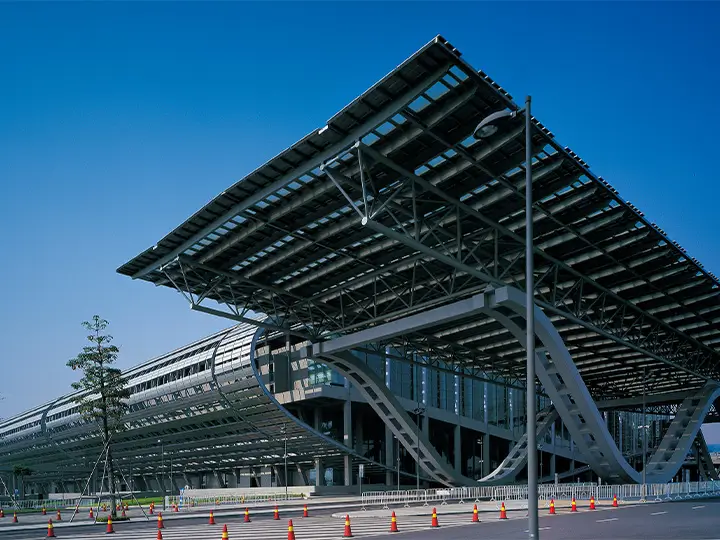
Modern steel bridge design prioritizes environmental performance: roof-mounted PV systems on steel bridge structures generate renewable energy; lightweight steel decks reduce foundation size and excavation; and modular construction minimizes on-site waste. Future innovations include self-monitoring steel structures (integrating fiber-optic sensors to detect fatigue cracks) and 3D-printed steel nodes for complex geometries, further enhancing efficiency and durability.
Conclusion
Steel structures have redefined the possibilities of bridge engineering, merging unmatched span capability with structural efficiency and architectural versatility. From urban footbridges to transcontinental crossings, steel’s unique properties—strength, adaptability, and recyclability—address the core demands of modern transportation infrastructure. As materials technology and construction methods evolve, steel will remain at the forefront of bridge innovation, enabling safer, more sustainable, and more iconic crossings that connect communities and drive economic growth. Compliance with global standards (AASHTO, Eurocode, GB 50017) ensures that steel bridges not only push engineering boundaries but also deliver reliable performance for generations.